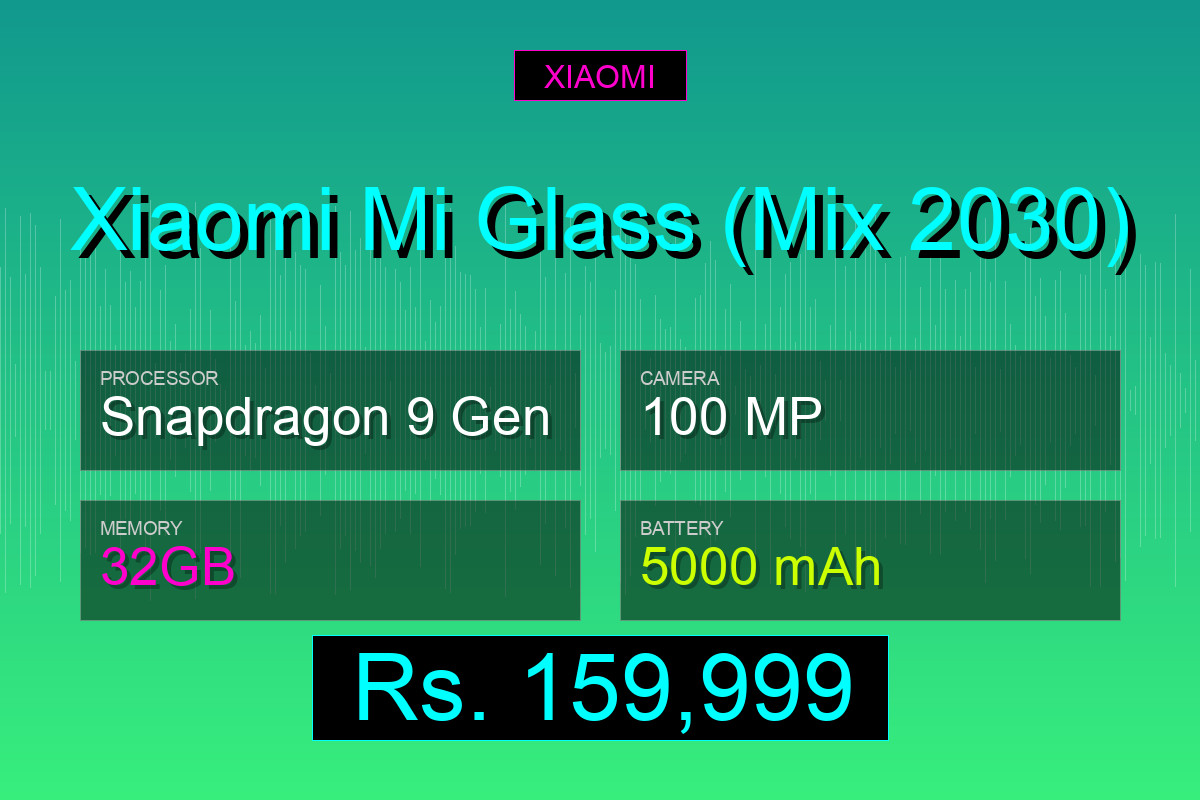
Xiaomi Mi Glass (Mix 2030)
Technology clearly seen.
| Network | GSM / HSPA / LTE / 5G / 6G |
| Launch | 2030 November 20 |
| Body | Dimensions: 160 x 74 x 8.0 mm Weight: 188 g Build: Fully Transparent Glass Body Invisible Circuits SIM: eSIM Only Holographic Projection |
| Display | Type: Transparent OLED 120Hz Size: 6.6 inches Res: 1200 x 2800 pixels Protection: Sapphire Crystal |
| Platform | OS: Android 20 (HyperOS 7.0) Chipset: Snapdragon 9 Gen 1 (1.0 nm) CPU: Octa-core GPU: Adreno 1400 |
| Memory | Card slot: No Internal: 1TB 32GB RAM 2TB 48GB RAM UFS 6.0 |
| Camera | Dual: 100 MP (wide) Under-Glass + 100 MP (ultrawide) Under-Glass Features: Invisible Electronics Dual-Sided Touch AR Projection Video: 8K@120fps |
| Sound | Loudspeaker: Yes bone conduction 3.5mm jack: No WLAN: Wi-Fi 9 Bluetooth: 7.5 NFC: Yes |
| Battery | Type: Transparent Graphene 5000 mAh Charging: 100W Wireless Air Charge |
Duration: 12 Months


Is it really transparent?
Yes, roughly 90% transparency. You can see your hand through it clearly.
Where is the battery?
It uses a grid of microscopic transparent graphene capacitors.
Where is the processor?
Hidden in the ultra-thin opaque chin at the bottom (3mm tall).
How do I charge it?
Xiaomi Air Charge beams energy to the phone from a base station up to 5 meters away.
Can I touch the back?
Yes! You can scroll and click from the back glass to keep the front smudge-free.
Is the camera visible?
No, the cameras are embedded in the glass structure and are invisible to the naked eye.
Is it fragile?
It is made of Sapphire Crystal, so it is scratch-proof, but can shatter if dropped on concrete.
How is privacy?
The screen can turn opaque (black) electrically for privacy mode.
Does it have speakers?
No, it uses bone conduction to transmit sound directly to your skull when held to your ear.
Is the display bright?
Transparent OLEDs are less bright (1500 nits max) but look futuristic.
Does it utilize AR?
Yes, you can hold it up to the world to overlay maps and data on real-life objects.
Is it 6G?
Yes.
Does it have a SIM slot?
No, eSIM only.
How much RAM?
32GB standard.
Does it get fingerprints?
Yes, but an oleophobic nano-coating repels oils instantly.