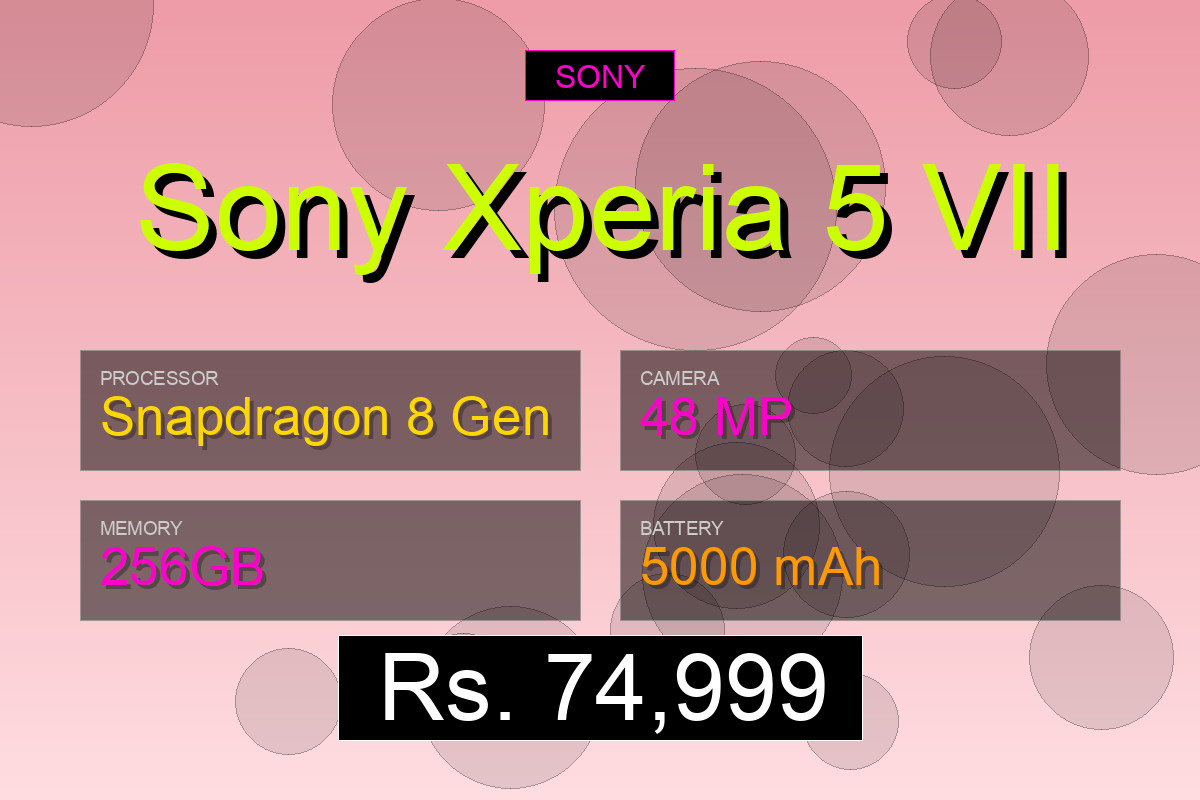
Sony Xperia 5 VII
Small size. Massive power.
| Network | GSM / HSPA / LTE / 5G |
| Launch | 2027 September 01 |
| Body | Dimensions: 154 x 68 x 8.3 mm Weight: 172 g Build: Glass front (Victus 3) Matte Glass back Aluminum frame SIM: Hybrid Dual SIM Compact Form Factor |
| Display | Type: OLED 120Hz BT.2020 2000 nits Size: 6.1 inches Res: 1080 x 2520 pixels (21:9) Protection: Gorilla Glass Victus 3 |
| Platform | OS: Android 17 Chipset: Snapdragon 8 Gen 6 (1.8 nm) CPU: Octa-core GPU: Adreno 1000 |
| Memory | Card slot: microSDXC Internal: 256GB 8GB RAM 512GB 12GB RAM UFS 4.1 |
| Camera | Triple: 48 MP (wide) Exmor-T + 12 MP (telephoto 3x) + 12 MP (ultrawide) Features: Zeiss Optics 3.5mm Jack Shutter Button Video: 4K@120fps HDR |
| Sound | Loudspeaker: Yes stereo speakers (Front Firing) 3.5mm jack: Yes WLAN: Wi-Fi 7 Bluetooth: 6.0 NFC: Yes |
| Battery | Type: Li-Po 5000 mAh Charging: 45W wired Wireless |
Duration: 12 Months


Is it really small?
Yes, it is very narrow (68mm width), making it the easiest phone to use with one hand.
Does it sacrifice power?
No, it runs the same Snapdragon 8 Gen 6 as the big flagships.
How is the battery life?
Incredible. 5000mAh in a small 60Hz-optimized phone lasts 2 days.
Is the camera good?
It uses the same main sensor as the Xperia 1, so quality is top-tier.
Does it have the continuous zoom?
No, to save space, it uses a fixed 3x telephoto lens.
Does it overheat?
Sony increased the chassis thickness slightly to add a bigger vapor chamber.
Is it waterproof?
Yes, IP65/IP68 rated.
Is the screen 4K?
No, it is FHD+ (1080p), which is better for battery life on a small screen.
Does it have a headphone jack?
Yes! And High-Res Audio support.
Can I use an SD card?
Yes, tool-free slot supports 1.5TB cards.
Is the vibration motor good?
Yes, Sony's Dynamic Vibration System syncs with movies/games.
Does it come with a charger?
No.
How fast is charging?
45W wired. Slower than Chinese phones but safe for the battery.