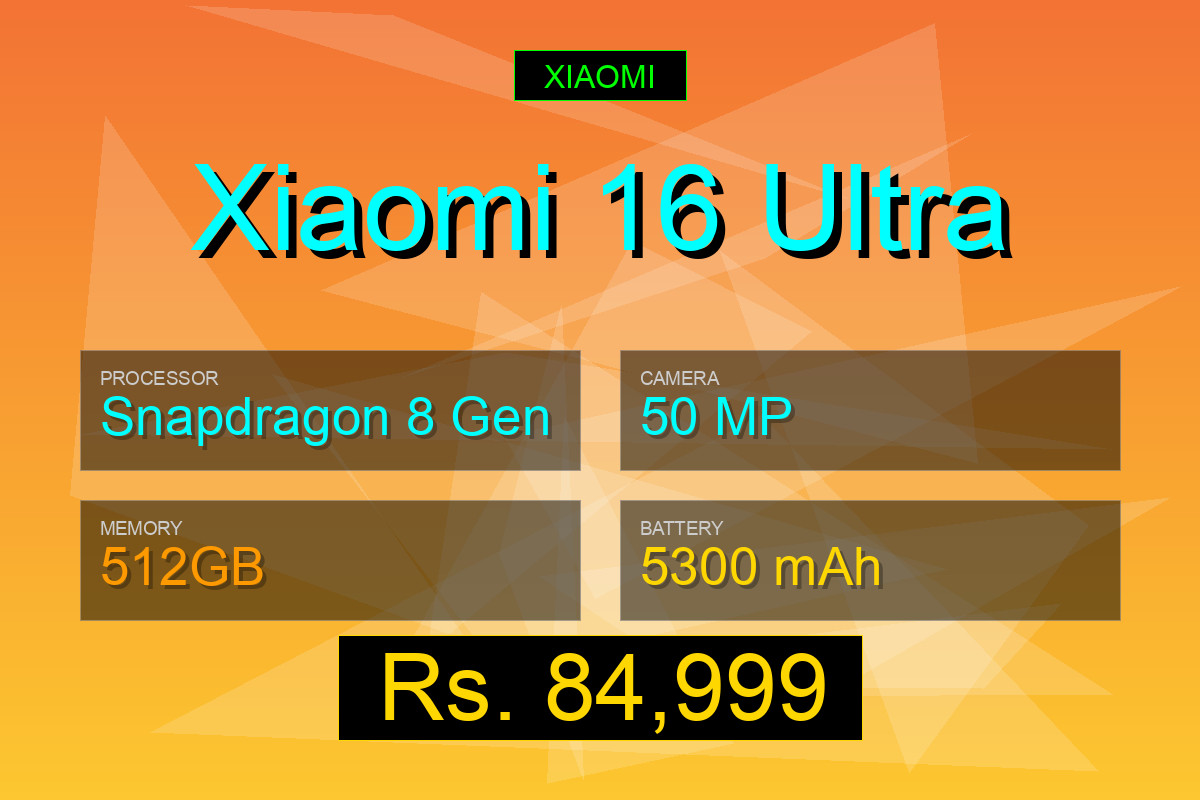
Xiaomi Flagship
Xiaomi 16 Ultra
₹84,999
A professional camera attached to a phone.
Processor
OS: Android 16 (HyperOS 2.0)Chipset: Snapdragon 8 Gen 4 (3 nm)CPU: Octa-coreGPU: Adreno 830
Camera
Quad: 50 MP (1-inch wide) Variable Aperture + 50 MP (periscope 5x) + 50 MP (telephoto 3.2x) + 50 MP (ultrawide)Features: Leica Summilux Lens Photography Kit SupportVideo: 8K@30fps 4K@120fps Log
Display
Type: LTPO AMOLED 120Hz 12-bit 3500 nitsSize: 6.73 inchesRes: 1440 x 3200 pixelsProtection: Xiaomi Shield Glass
Battery
Type: Li-Po 5300 mAhCharging: 90W wired 80W wireless
Technical Specifications
| Network | GSM / HSPA / LTE / 5G |
| Launch | 2026 April 20 |
| Body | Dimensions: 161.4 x 75.3 x 9.2 mm Weight: 229 g Build: Glass front Vegan Leather back Titanium frame SIM: Dual SIM IP68 dust/water resistant |
| Display | Type: LTPO AMOLED 120Hz 12-bit 3500 nits Size: 6.73 inches Res: 1440 x 3200 pixels Protection: Xiaomi Shield Glass |
| Platform | OS: Android 16 (HyperOS 2.0) Chipset: Snapdragon 8 Gen 4 (3 nm) CPU: Octa-core GPU: Adreno 830 |
| Memory | Card slot: No Internal: 512GB 16GB RAM 1TB 16GB RAM UFS 4.0 |
| Camera | Quad: 50 MP (1-inch wide) Variable Aperture + 50 MP (periscope 5x) + 50 MP (telephoto 3.2x) + 50 MP (ultrawide) Features: Leica Summilux Lens Photography Kit Support Video: 8K@30fps 4K@120fps Log |
| Sound | Loudspeaker: Yes stereo speakers 3.5mm jack: No WLAN: Wi-Fi 7 Bluetooth: 5.4 NFC: Yes |
| Battery | Type: Li-Po 5300 mAh Charging: 90W wired 80W wireless |
Smart Finance Plan
₹0 / mo
Duration: 12 Months


FAQ
Is the camera better than DSLR?
It's getting close. The 1-inch sensor and variable aperture offer natural bokeh.
What is the Photography Kit?
An accessory case that adds a grip, shutter button, and filter adapter (sold separately).
How fast is wireless charging?
Insane 80W. It charges wirelessly faster than most phones charge with a cable.
Does it have zoom?
Yes, two zoom lenses (3.2x and 5x) cover all portrait and bird-watching needs.
Is it heavy?
Yes, the large camera sensors and glass make it top-heavy and 229g.
Is the software good?
HyperOS is smooth, but still has some bloatware compared to Pixel/iPhone.
Is it waterproof?
Yes, IP68 rated.
Does the screen look good?
It is a 2K LTPO panel with Dolby Vision, absolutely stunning for media.
Does it overheat?
It gets warm while recording 4K/8K video, but cooling is improved.